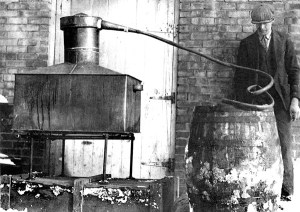
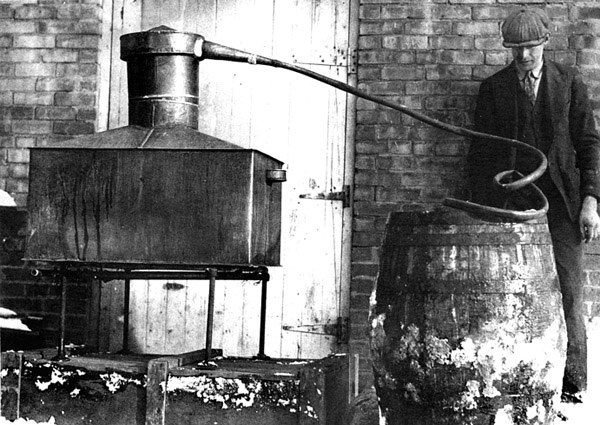
My father in law died at age 98. He was the son of a man who was a bootlegger during the crazy time in the United States when the government thought it could legislate morals. This period ran from 1920-1933. The Consitutional Amendment dealing with the prohibition on the sale, manufacture and distribution of alcoholic beverages was the 18th Amendment and was ratified in 1919. It was a dismal failure. My grandfather-in-law (who I never met) ran illegal whiskey for years. In fact, bottles of the stuff were still being found buried in his fields in the late 1970s, early 1980s. And, in a grand family tradition of illegality, my wonderful father in law (that always treated me like one of his own children) sold fireworks in the State of Alabama for many years. Over the years, he told me at least three times, in a voice full of regret, that he sure did make a lot more money selling his fireworks when he had to smuggle them in from Florida and they were illegal in Alabama. He regretted the day that the State of Alabama passed the law making them legal because he then had competition. He was a cool old guy- He also hoboed across the country to work the apple harvest as a young lad, but that’s another story.
The Prohibition Era was the impetus for a couple of interesting developments in this country. I’m going to talk about two of the long-term repercussions of Prohibition in this post. Two things that are still part of our culture. One is the emergence of organized crime and the other is Nascar racing.
Gangsters like Al Capone and Lucky Luciano made a lot of money supplying liquor and beer to the Speakeasys. Speakeasys were places a person could go to drink alcohol during this era. The worst kind of criminals became involved in this underground way of life. The era of the “organized” criminal had come and it has never left.

The good old boys in the south ran the illegal booze in small, fast cars. The cars were souped up to be fast enough to out run the police. One of the reasons that Prohibition was a bust was because there was no way to tax illegal products. At the end of prohibition, taxes were re-imposed on liquor and a brand new kind of Bootlegger was born: the Moonshiner. You see, some of those boys down south had been making their own hooch- not illegally importing the good stuff, but making their own. Their sales didn’t stop after the law was repealed. People still wanted to drink home-stilled booze. So, these guys still needed those fast cars. Only now they were out running the Revenuers. The tax men. They didn’t want to have to pay Uncle Sam his cut. So, fast cars to outrun cops continued to be developed. This was the birth of the tradition of racing cars.
Daytona was a popular place in the 1920s and 1930s to race to beat land speed records so it seems only right that Daytona Beach, Fla became the home to Nascar. I’m not a fan myself but some of my favorite people on this planet are big fans.
So, Prohibition ended but there was still the option of having “wet” counties vs. “dry” counties. There were still dry counties in Florida up to a few years ago. Every time there would be a vote on the wet/dry issue, I’d always say it was the only time the bootleggers and the Christian coalition were on the same side of an issue. Different reasons, but they voted the same.
 .
.






 Jillian Chantal